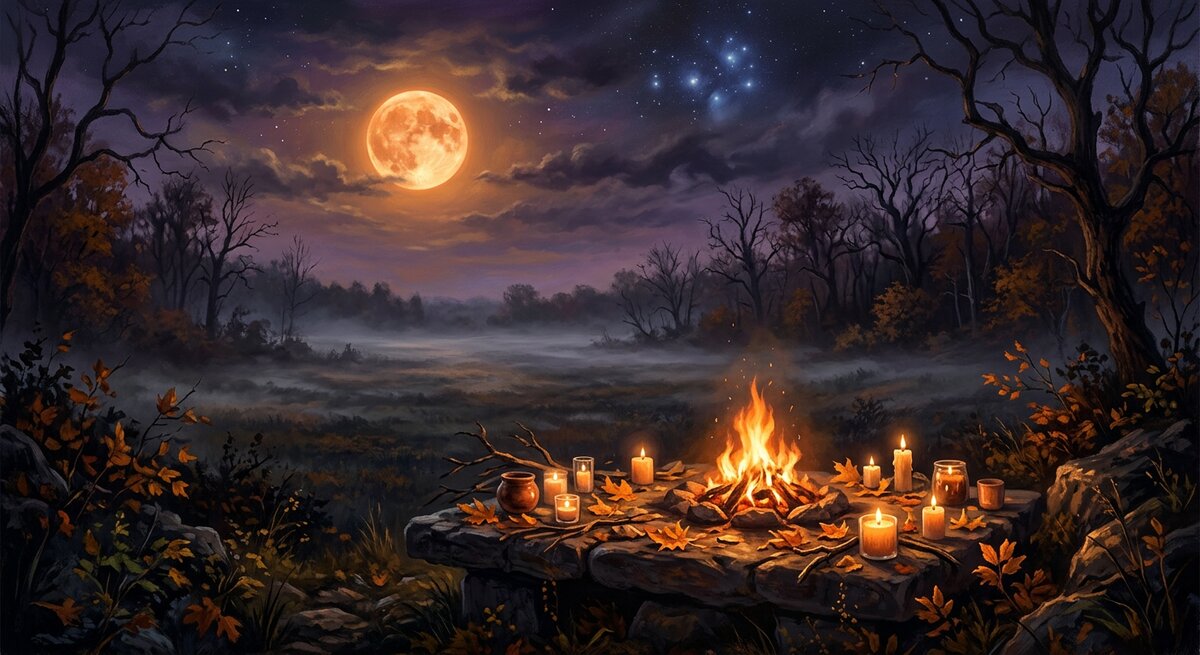
Samhain 2026 is almost here, and the calendar gives you two different answers. The traditional festival begins at sunset on Saturday, October 31, 2026 and runs to sunset on November 1. The astronomical moment that many astrologers treat as the true "thinning of the veil", the cross-quarter point when the Sun reaches 15 degrees of Scorpio, arrives about a week later on Saturday, November 7, 2026. This guide explains both dates, what Samhain means in the Celtic tradition and in modern spiritual practice, what the sky looks like that night, and simple ways to mark the turning of the year with intention.
Quick answer: Samhain 2026 is October 31 (sunset) to November 1 by tradition, and the astronomical cross-quarter falls on November 7, 2026 at 09:52 UTC. The nearest full moon is the Hunter's Moon on October 26, and on Samhain night the Moon is a waning gibbous, about 59 to 60% lit.
Samhain 2026 dates at a glance
| Event | Date and time (UTC) | Why it matters |
|---|---|---|
| Sun enters Scorpio | October 23, 09:38 UTC | Start of Scorpio season, the sign of depth and endings |
| Mercury stations retrograde | October 24, about 07:15 UTC, at about 21 degrees Scorpio | Review period, fitting for reflection and ancestors |
| Hunter's Moon (full moon in Taurus) | October 26, 04:12 UTC | Nearest full moon to Samhain |
| Traditional Samhain | Sunset October 31 to sunset November 1 | Folk and calendar date, Halloween and All Saints' Eve |
| Astronomical cross-quarter | November 7, 09:52 UTC | Sun at 15 degrees Scorpio, midpoint of autumn and winter |
| New Moon in Scorpio | November 9 | A natural moment to set intentions |
Sun, Moon and Mercury times come from published astronomical and astrological calendars (converted to UTC from the Eastern times they list). In Tunisia, UTC+1, add one hour: the cross-quarter lands at 10:52 on November 7.
What is Samhain?
Samhain (pronounced SOW-in) is one of the four Gaelic seasonal festivals, alongside Imbolc, Bealtaine and Lughnasa. Early Irish texts describe it as the end of the harvest and the start of the dark half of the year, a time of gatherings, feasts and bonfires when the boundary between this world and the otherworld was believed to be thin. Many Halloween customs, such as guising, turnip lanterns and divination games, come from Samhain traditions in Ireland and Scotland.
In the twentieth century modern Pagans, including Wiccans and Druids, made Samhain one of the eight sabbats of the Wheel of the Year, often as a time to remember the dead. Many people today treat it simply as a seasonal threshold: a moment to let go of what the year has finished with and to prepare for the quiet months.
Why there are two Samhain dates
The festival is kept on fixed calendar dates, October 31 and November 1. Astronomically, however, Samhain is a cross-quarter day: the midpoint between the autumn equinox (September 22 in 2026) and the winter solstice (December 21). That midpoint is reached when the Sun is 225 degrees along the ecliptic, or 15 degrees of Scorpio, which in 2026 happens on November 7. EarthSky points out that the October 31 date is fixed by tradition, that the true cross-quarter day falls about a week later, and that for the ancient Celts a cross-quarter day marked the beginning of a season rather than its middle.
Which date should you use? There is no wrong answer. Use October 31 if you want to join the shared cultural moment, November 7 if you follow the Sun, or the nearest new or full moon if you follow the Moon. Some people simply mark all three. Southern Hemisphere practitioners usually celebrate around April 30 to May 1, with the astronomical point on May 5, 2026.
Samhain and Scorpio season
Samhain always falls while the Sun moves through Scorpio, the sign associated with transformation, endings, secrets and depth. That overlap is why the two feel so compatible in astrology. On October 31 the Sun sits at about 8 degrees of Scorpio by sign, even though against the background stars it is still in the constellation Libra, because the zodiac signs have drifted about a month from the constellations since they were named. For a wider look at the season, see our guide to Scorpio season 2026.
This year Scorpio season also arrives with Mercury retrograde beginning on October 24. If you want the practical side of that review period, read our article on Mercury retrograde in Scorpio. Retrograde Mercury is traditionally linked with revisiting the past, which suits Samhain's focus on memory, ancestors and unfinished business.
The sky on Samhain night 2026
Even if astrology is not your lens, the night sky around Samhain is worth stepping outside for.
The Hunter's Moon and a waning gibbous Moon
The full moon after the Harvest Moon is the Hunter's Moon. In 2026 it peaks on October 26 at 04:12 UTC (12:12 a.m. Eastern) in Taurus, opposite the Sun in Scorpio, with no eclipse and not a supermoon. By Halloween the Moon is a waning gibbous around 59% lit, rising late in the evening. We covered the full moon in detail in our Hunter's Moon 2026 guide.
The Pleiades rising
As darkness falls the Pleiades star cluster, the Seven Sisters, rises in the northeast to east-northeast and climbs all night, reaching its highest point around midnight to 1 a.m. It marks the turn of the year for many peoples, from ancient Greece to the Maori. A direct link between the Pleiades and Samhain in early Ireland is a popular modern idea rather than something the old Irish texts record, but anyone outdoors on Samhain night can watch the cluster rise just above Aldebaran, the orange eye of Taurus.
Halloween fireballs: the Taurids
The Taurid meteor shower is active from September to early December and is strongest from late October to mid November. Rates are low, about five an hour, but the meteors are slow and often bright, which is why astronomers nickname them the Halloween fireballs. They come from debris of Comet Encke and appear to radiate from Taurus, beside the Pleiades.
What Samhain means spiritually
Spiritual meaning is personal, but several themes appear in most traditions that keep this festival.
- Endings and gratitude. Samhain marks the end of the harvest. Many people use it to name what the year has produced and what they are ready to release.
- Remembering the dead. Ancestor altars, photographs, candles and a "dumb supper" (a silent meal with a place set for the departed) are common customs.
- Divination and reflection. Tarot, journaling, pendulum work and dream attention are traditionally associated with this threshold.
- Rest and preparation. The dark half of the year invites slower rhythms, shorter to-do lists and inner work.
Treat these as traditions and tools for reflection, not guarantees of any outcome. If you are curious about how personal numbers and cycles fit into this kind of reflection, our guide to calculating your life path number is a good companion read.
How to celebrate Samhain 2026: simple ideas
- Set the date you will honor. Choose October 31, November 7 or the nearest moon. Put it in your calendar so it does not slip by.
- Create a small ancestor altar. A candle, a photograph, a seasonal item such as an apple or a leaf, and a glass of water are enough.
- Write two lists. One of what you are grateful for this year, one of what you are ready to release. Keep the first, burn or bury the second safely.
- Share a seasonal meal. Apples, nuts, root vegetables, squash and bread are traditional. In Ireland, colcannon and barmbrack are customary at this time.
- Go outside after dark. Find the Pleiades, watch for a Taurid, note the late-rising Moon.
- Close with an intention. The new moon on November 9 is a natural next step for fresh intentions. See our guide to the New Moon in Scorpio on November 9, 2026.
Use real flame carefully and never leave candles unattended. If a ritual involves anything that affects your health, finances or relationships, treat it as reflection only and seek qualified advice for real decisions.
Samhain, Halloween and Dia de los Muertos: how they connect
Halloween is the Christian eve of All Saints' Day on November 1, which took on many older Samhain customs in Ireland and Scotland. Today it is mostly a secular holiday, while Samhain is kept as a religious or seasonal festival by many Pagans. Dia de los Muertos on November 1 and 2 is a distinct Mexican tradition with its own roots, but it shares the theme of honoring those who have died at the turn of the season. No country keeps Samhain itself as a public holiday, though Ireland has a bank holiday on the last Monday of October and November 1 is a public holiday in many Catholic countries.
What the transits add this year
Astrologers note that this Samhain season combines a Taurus full moon square Pluto on October 26, a Mercury retrograde review period and a Venus retrograde cycle in Scorpio and Libra. In plain language, the themes are security versus change, revisiting old agreements and looking honestly at what you value. You do not need to believe in astrology to find those themes useful prompts for reflection, and you do not need to treat them as predictions.
FAQ
When is Samhain in 2026?
Traditionally from sunset on Saturday, October 31, 2026 to sunset on November 1. The astronomical cross-quarter point is November 7, 2026 at 09:52 UTC.
What is the difference between Samhain and Halloween?
Halloween is the Christian eve of All Saints' Day that absorbed many Samhain customs. Samhain is the older Gaelic seasonal festival and a Wheel of the Year sabbat that many Pagans keep as a religious or seasonal observance.
Why is Samhain sometimes celebrated on November 7?
Because the true cross-quarter day, when the Sun reaches 15 degrees of Scorpio, falls about a week after October 31. Some people celebrate on that astronomical date.
What phase is the Moon on Halloween 2026?
A waning gibbous, about 59 to 60% illuminated. The full Hunter's Moon was on October 26.
When is Samhain in the Southern Hemisphere?
Many Southern Hemisphere practitioners celebrate around April 30 to May 1, and the astronomical point in 2026 is May 5.
What do people do on Samhain?
Common customs include bonfires, ancestor altars, a silent supper for the dead, divination, carving turnips or pumpkins, and marking the turn from autumn to winter.
Why is Samhain called the witches' new year?
Many modern Pagans treat it as the start of the year, following the idea that the Celtic year began with the dark half. Historians debate how old that idea is, but it is widely kept today.
Is Samhain a public holiday?
No country keeps Samhain itself as a public holiday, although November 1 is a public holiday in many Catholic countries.
Final thoughts
Samhain 2026 gives you a rare choice between two meaningful dates, a Hunter's Moon on the doorstep and a Scorpio Sun at its deepest. Whether you light a candle on October 31, watch the Pleiades rise or mark the cross-quarter on November 7, the heart of the festival is the same: honor what has ended, remember those who came before and enter the dark half of the year on purpose.
Sources: whatsupsky.com Samhain 2026; EarthSky, "Halloween is an astronomy holiday"; Natal Junction, Scorpio season 2026 dates; Space.com and Almanac.com for the October 2026 Hunter's Moon; EarthSpirit Almanac 2026. Spiritual and astrological meanings are traditions and personal reflection, not predictions or advice.