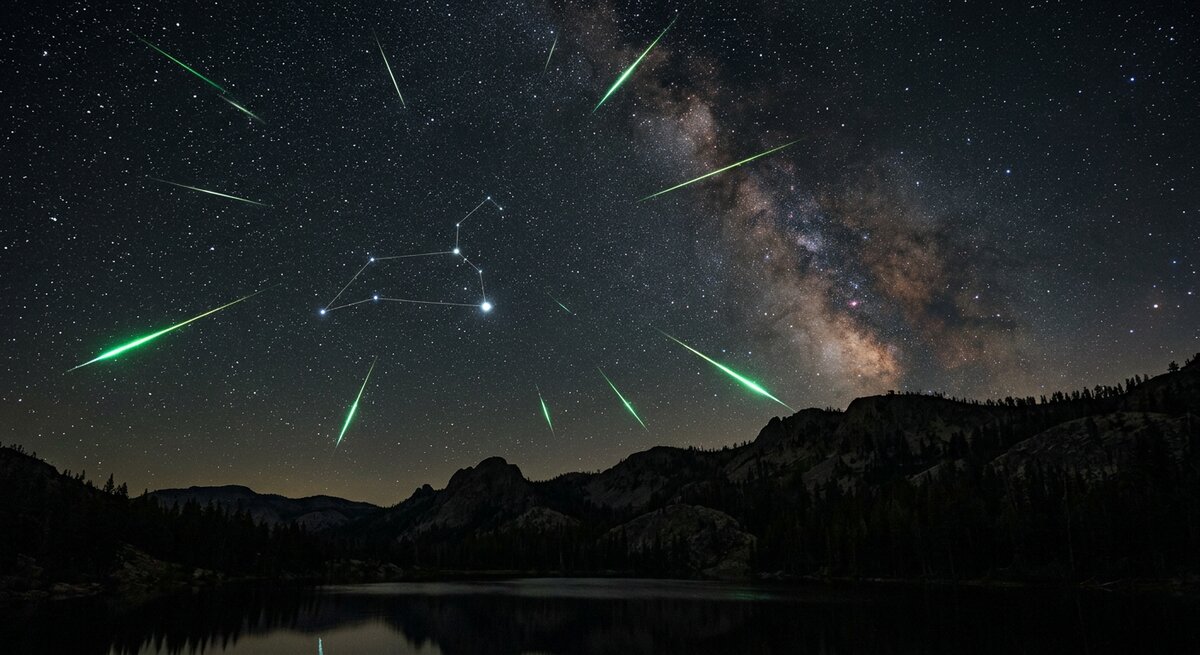
The Leonid meteor shower is one of the fastest and brightest showers of the year, and in 2026 it arrives at a nicely timed moment: just over a week after the November 9 new moon and a few days before the November 24 full moon. This guide gives you the dates, the best viewing hours, what to expect honestly and a few grounded ways to make the night meaningful.
Leonid meteor shower 2026: key dates
- Active: about November 6 to 30, 2026.
- Peak: the night of November 17 into November 18. The International Meteor Organization places the regular maximum at about 23:45 UT on November 17, and EarthSky lists a predicted peak at 0 UT on November 18.
- Expected rate: roughly 10 to 15 meteors per hour under dark skies, which is a normal year, not a storm. Experts say no Leonid storm is expected in 2026.
- Radiant: in Leo, rising around midnight and highest near dawn.
- Parent comet: 55P/Tempel-Tuttle, which returns to perihelion in 2031.
Moon conditions on peak night
The first quarter moon falls at 11:48 UT on November 17, according to EarthSky. A quarter moon sets around midnight, so moonlight can wash out the faintest meteors early in the evening, but the sky should be darker later, when the radiant climbs higher. Plan to watch after the moon sets, from about midnight until dawn. Sources differ a little on the exact illumination figure, so check your local moonset time.
| Date (2026) | Event |
|---|---|
| Nov 9 | New moon in Scorpio |
| Nov 17 | First quarter moon (11:48 UT); Leonid peak night begins |
| Nov 18 | Peak continues in the pre-dawn hours |
| Nov 24 | Full moon in Gemini |
How to watch the Leonids
- Pick a dark spot. Get away from streetlights. Dark sites give far higher counts than a city centre.
- Look after midnight. The radiant rises around midnight and is highest before dawn.
- Give your eyes 20 minutes. Avoid your phone, or use a red light.
- Lie back and look wide. You do not need a telescope or binoculars. Take in as much sky as you can, not just Leo.
- Dress warmly. November nights are cold; bring a blanket and a hot drink.
- Be flexible. If peak night is cloudy, nights around it still produce meteors.
What makes Leonids special
Leonids hit the atmosphere at about 71 km per second, making them among the fastest meteors. Many are bright, and a good share leave glowing trains that linger for a moment. The shower is famous for historic storms, with thousands of meteors an hour seen in 1833, 1966 and 2001, but those happened when Earth crossed a fresh, dense trail from the comet. The comet is far from Earth now, so modern years are modest.
The meaning people give to meteor showers
Astronomy explains what you see: dust from a comet burning up in the atmosphere. Many people also use these nights as a time for reflection, and traditions around shooting stars, from making a wish to marking a season, are old and widespread. We treat that as personal meaning, not prediction.
- Leo themes: courage, creativity and visibility. The shower's radiant sits in the constellation Leo, so it is a natural moment to ask what you want to express.
- Timing with the moon: the new moon on November 9 is a classic point for setting intentions, and the November 24 full moon is a point to review them. The Leonids fall between the two.
- A simple ritual: before you go out, write one thing you want to begin and one thing you want to release. Look up. Come back and put the paper away.
For the surrounding sky events, see our guides to the Mercury direct on November 13, the Samhain cross-quarter date and Sagittarius season.
Leonids vs other November showers
| Shower | Peak (2026) | Typical rate | Parent |
|---|---|---|---|
| Southern Taurids | About Nov 5 | About 5 per hour | Comet 2P/Encke |
| Northern Taurids | About Nov 12 | About 5 per hour | Comet 2P/Encke |
| Leonids | Nov 17 to 18 | About 10 to 15 per hour | Comet 55P/Tempel-Tuttle |
Photography tips
Use a tripod, a wide-angle lens, a high ISO and an exposure of about 15 to 25 seconds. Point the camera towards the eastern sky after midnight, take many frames, and keep the best ones. Do not expect every frame to catch a meteor.
FAQ
When is the Leonid meteor shower in 2026?
It is active from about November 6 to 30 and peaks on the night of November 17 into November 18, with the best viewing after midnight.
Will there be a Leonid meteor storm in 2026?
No. Experts expect a normal year with roughly 10 to 15 meteors per hour under dark skies.
What is the best time to watch the Leonids?
After the quarter moon sets around midnight and before dawn, when the radiant is high.
Do I need a telescope to see the Leonids?
No. Your eyes are best. Lie back and take in the whole sky.
Which zodiac sign is linked to the Leonids?
The radiant is in the constellation Leo, which is why many people link the shower with Leo themes. This is symbolic, not scientific.
Final thoughts
The 2026 Leonids are a modest but beautiful show, framed by two lunar milestones. Choose a dark place, wait for the moon to set, and let the night be both an astronomy lesson and a moment of reflection.
Sources: EarthSky Leonid meteor shower guide; International Meteor Organization 2026 calendar; MeteorShowerCal Leonids 2026 page; timeanddate.com. Timings are given in UT; convert to your local time zone.