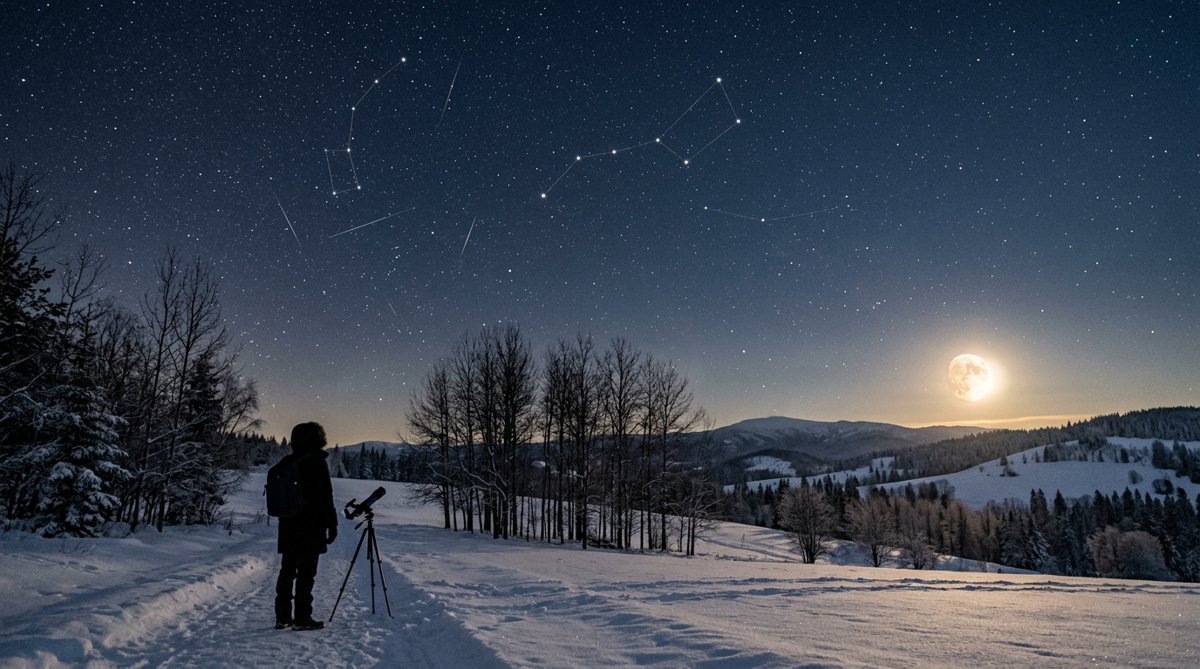
The Ursid meteor shower is the quiet one. It arrives in the last week of the year, a few days after the winter solstice, when many people are busy with holidays and nobody is looking up. In 2026 it peaks on the night of December 21 to 22, and a bright waxing gibbous Moon will be in the sky. This guide gives you the verified dates, a realistic expectation of what you will see, a simple plan for beating the moonlight, and a reflective section on why a faint shower can still be a meaningful ritual.
Ursid Meteor Shower 2026: The Key Facts
According to the American Meteor Society's 2026 meteor calendar, the Ursids are active from December 17 to 26, with the peak night on December 21 to 22. The Moon will be about 89% illuminated on peak night (a waxing gibbous), so moonlight will wash out the fainter meteors. The AMS describes the shower as often neglected because it peaks just before Christmas and has much lower rates than the Geminids a week earlier.
| Detail | 2026 value |
|---|---|
| Active dates | December 17 to 26 |
| Peak night | December 21 to 22 |
| Typical rate | About 5 to 10 meteors per hour under good conditions |
| Rare outbursts | Occasionally above 25 per hour |
| Moon on peak night | About 89% illuminated, waxing gibbous |
| Speed | About 33 km/s (medium-slow) |
| Parent body | Comet 8P/Tuttle |
| Best hemisphere | Northern Hemisphere |
Because the radiant sits near the bowl of the Little Dipper, it never really sets for observers at mid-northern latitudes. That is good news: you can watch at almost any hour of the night, not only before dawn. The AMS notes that the shower is strictly a northern-hemisphere event, since the radiant fails to clear the horizon from the southern tropics.
Where Do the Ursids Come From?
Every meteor shower is Earth passing through a trail of dust left by a comet or asteroid. The Ursids come from comet 8P/Tuttle, a periodic comet that circles the Sun roughly every 13.6 years. Tiny grains, often no larger than a grain of sand, strike the upper atmosphere and burn up in a streak of light. They are named for Ursa Minor, the Little Bear, the constellation they appear to radiate from. The radiant is close to the star Kochab, the "guardian" of the northern pole.
The AMS also points out that past outbursts, when rates passed 25 per hour, do not seem tied to the comet's closest approach to the Sun. In plain language, nobody can reliably predict an Ursid surprise. That unpredictability is part of the charm, and also a reason to keep expectations modest.
What Will You Actually See in 2026?
Be honest with yourself before you go out in the cold: with a nearly full Moon, you will probably see a handful of meteors per hour at most, and the fainter ones will vanish. The brightest Ursids can still cut through moonlight. Expect a slow, patient experience, rather than the fireworks of the Geminids. If you want a high-rate show, read our guide to the Geminid meteor shower 2026 first, since it peaks only a week earlier and is usually the best shower of the year.
A Simple Moonlight Plan
- Put the Moon behind a building or tree. Face away from it, and look at the dark sky about 45 degrees up, not at the Moon itself.
- Choose the late hours. The Moon sets later in the night during this period, so the darkest sky comes after it drops, or before dawn.
- Look on several nights. The shower is active from December 17 to 26. A fainter night with less moonlight, at the edges of the range, can still give you a few meteors.
- Dress for the cold. A reclining chair, a sleeping bag, and a warm drink matter more than any equipment.
- Skip the binoculars. Meteors cover too much sky. Your eyes, adapted to the dark for 20 to 30 minutes, are the best tool.
Observing Checklist
- Check your local weather and cloud forecast a day ahead.
- Find a place away from street lights, even a dark corner of a yard.
- Let your eyes adapt, and avoid your phone screen, or use a red light.
- Count the meteors you see and write down the time of each one.
- Repeat on a second night and compare.
The Sky Around the Ursids: Late December 2026
The Ursids do not happen alone. They arrive right after the December solstice, the shortest day of the year in the Northern Hemisphere. If you enjoy marking the turning of the year, our winter solstice 2026 guide covers the date and reflective rituals. The same month also brings Jupiter's apparent backward motion, explained in our post on Jupiter retrograde in Leo in December 2026. Together, these make late December a good stretch for looking up.
| Event | Why it matters for a stargazer |
|---|---|
| Ursids active (Dec 17 to 26) | Long window to try several nights |
| Ursid peak (night of Dec 21 to 22) | Best odds, but bright Moon |
| Winter solstice (December 2026) | Longest night in the north, more dark hours to observe |
A Reflective Take: Why a Faint Shower Can Still Matter
This section is reflection, not prediction. Meteor showers have no proven influence on your life, your luck, or your future, and no scientific source says otherwise. But people across many cultures have always used the night sky as a mirror, and you are free to do the same.
The Ursids happen in the quietest week of the year. For some people, that makes them a natural moment to pause, review the year, and ask what they are ready to release. A falling streak of light can be a simple cue: when you see one, take a slow breath and name one thing you are letting go of, or one intention you want to carry into the new year.
A Ten-Minute Ritual for Peak Night
- Go outside and stand or sit for five minutes without a phone, letting your eyes adapt.
- Think of one lesson from the past twelve months.
- Each time a meteor appears, silently repeat it, or thank someone who helped you.
- Finish by writing one sentence about what you want more of in the year ahead.
Nothing mystical needs to happen for this to work. The value is the pause, the cold air, and the attention. If cloud covers the sky, do the same ritual indoors by a window.
Ursids Compared With Other Winter Showers
| Shower | Typical strength | Notes |
|---|---|---|
| Geminids | High, among the year's best | Peaks about a week before the Ursids |
| Ursids | Low, about 5 to 10 per hour | Neglected, north only, rare outbursts |
| Quadrantids | High but short peak | Early January, narrow window |
If you only have energy for one night out, the Geminids are the stronger choice. But the Ursids reward people who like quiet, uncrowded skies and the feeling of seeing something most people overlook.
Frequently Asked Questions
When is the Ursid meteor shower peak in 2026?
The peak night is December 21 to 22, 2026, with the shower active from December 17 to 26, according to the American Meteor Society.
How many Ursid meteors can I see per hour?
Under good conditions observers usually see about 5 to 10 per hour. In 2026 the bright Moon will lower that count, so expect fewer.
Will the Moon ruin the 2026 Ursids?
It will hurt, since the Moon will be about 89% illuminated on peak night. You can still see the brighter meteors if you keep the Moon out of your view and look at a dark part of the sky.
Can people in the Southern Hemisphere see the Ursids?
Mostly no. The shower is strictly a northern-hemisphere event, because the radiant barely rises, or rises with the morning twilight, in the southern tropics.
Where do the Ursids come from?
They come from dust left behind by comet 8P/Tuttle, and appear to radiate from the constellation Ursa Minor, the Little Bear.
Do meteor showers have a spiritual meaning?
There is no scientific evidence that they affect events in your life. Many people use them as a prompt for reflection and intention setting, which is a personal practice rather than a fact.
What is the best time of night to watch?
Because the radiant stays above the horizon for mid-northern observers, you can watch all night. Late night or pre-dawn, when the Moon is lower or gone, usually offers the darkest sky.
Do I need a telescope?
No. Telescopes and binoculars narrow your view. Use your eyes, a dark site, and about 30 minutes of patience.
Final Thoughts
The Ursids will not be the brightest show of 2026, and the Moon will compete with them. Still, they are a gentle, low-pressure reason to step outside in the last week of the year. Plan a window of a few nights, keep the Moon out of your sight, and treat any meteor you catch as a bonus. Whether you see five or fifty, the habit of looking up is the real reward.
Sources
- American Meteor Society, 2026 Meteor Shower Calendar: amsmeteors.org/calendar
- EarthSky, meteor shower guide: earthsky.org
- NASA Science, Meteors and Meteorites: science.nasa.gov