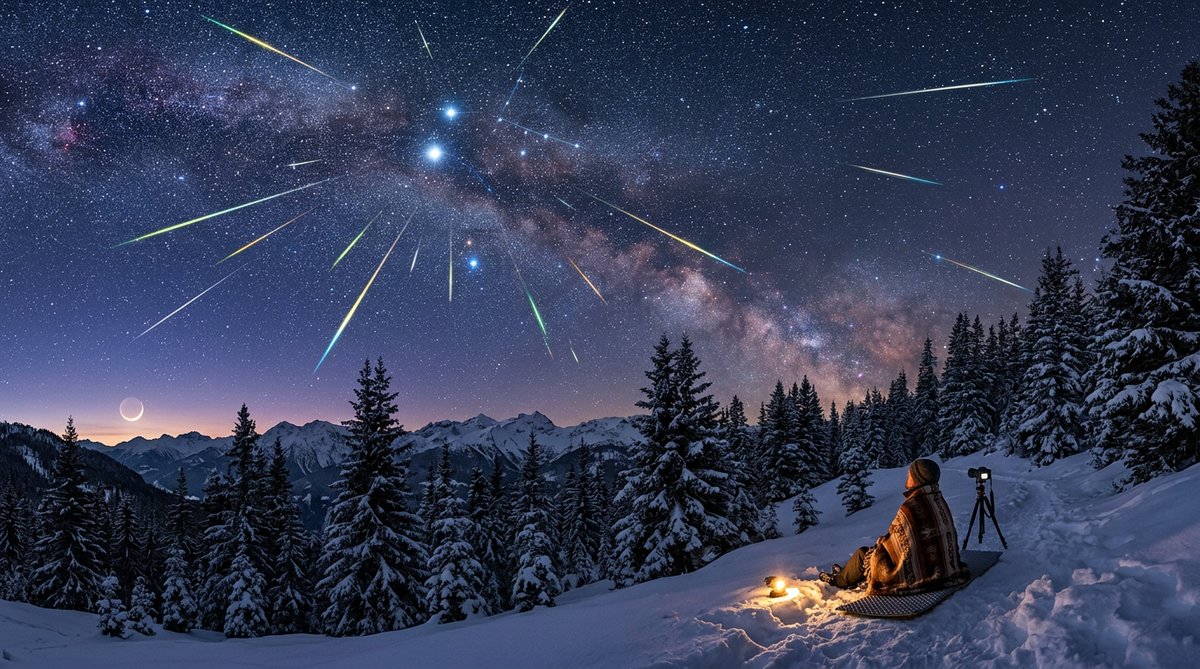
The Geminid meteor shower is the strongest and most dependable meteor shower of the year, and in 2026 it gets a gift: a dark sky. The peak falls on the night of December 13–14, 2026, only a few days after the new moon, so a thin crescent moon sets early in the evening and leaves the rest of the night free for meteors.
This guide gives you the dates, the real peak time (and why different websites quote different hours), the best night for your part of the world, what the moon is doing, and how to turn a cold December night into a quiet ritual of reflection at the close of the year.
Geminid meteor shower 2026 at a glance
| Detail | 2026 value |
|---|---|
| Active period | December 4 to 17 (NASA, American Meteor Society); December 4 to 20 (International Meteor Organization, Royal Observatory Greenwich) |
| Peak night | Night of Sunday December 13 to Monday December 14 |
| Predicted maximum | December 14, around 14:00 UTC (IMO); EarthSky gives 05:44 UTC on December 14 |
| Rate under ideal dark skies | About 120 to 150 per hour in theory (ZHR); NASA says 40 to 50 per hour is a realistic dark-sky count |
| Moon on peak night | Waxing crescent, roughly 15 to 25% lit, sets around 9 to 10 pm local time |
| Radiant | Near the bright star Castor in Gemini; rises in the early evening |
| Speed | About 35 km/s (22 miles per second), slow and easy to follow |
| Parent body | Asteroid 3200 Phaethon (a "rock comet") |
Sources: NASA, American Meteor Society, Royal Observatory Greenwich and EarthSky.
When is the Geminid meteor shower peak in 2026?
Every major source agrees on the night: December 13 into December 14, 2026. Where they differ is the exact hour of maximum, and that confuses a lot of readers.
Why websites quote different peak times
The International Meteor Organization (IMO) defines the Geminid maximum by the point in Earth's orbit where activity has historically been highest, a solar longitude of about 262.2 degrees. In 2026, Earth reaches that point on December 14 at about 14:00 UTC. EarthSky, using a different model, lists 05:44 UTC on December 14.
Neither number is wrong. The Geminid peak is broad, and over the last twenty years the strongest activity has landed anywhere in a window of almost a day. Rates stay high for many hours on either side of the maximum. So do not obsess over the minute. Focus on the night, and on getting away from lights after the moon has set.
The best night for your region
| Where you are | Best time to watch | Why |
|---|---|---|
| North America | Night of Dec 13–14, especially 1 am to 4 am | The radiant is high and the predicted peak is only hours after dawn |
| Europe, North Africa, Middle East | Pre-dawn Dec 14, then again the evening of Dec 14 | The maximum falls during your daytime, so both nights around it are good |
| East Asia | Night of Dec 14–15 | Your first dark hours come soon after the maximum |
| Australia, New Zealand, South America | Night of Dec 13–14 or 14–15, between about 1 am and 3 am | Gemini stays low, so rates are lower, but the peak hours are still worth it |
If clouds spoil the main night, do not give up. The nights of December 12–13 and 14–15 still show good activity, and the moon is just as kind on those dates.
Will the moon spoil the Geminids in 2026?
No, and this is the best news of the year for meteor watchers. The new moon falls on December 9, 2026 (UTC). By peak night the moon is a slim waxing crescent, about a fifth lit, low in the west after sunset. The Royal Observatory Greenwich expects it to set around 9:20 pm in the UK, and most northern locations see it gone by about 9 to 10 pm.
That leaves roughly eight hours of moonless dark, which is exactly when the Gemini radiant climbs highest. Compare that with the Leonids a month earlier, or the Ursids a week later, when an 89% lit moon washes out the sky on December 21–22.
December 2026 moon calendar for sky watchers
| Date (UTC) | Moon phase | What it means for watching |
|---|---|---|
| December 9 | New moon (in Sagittarius) | Darkest skies; early Geminids begin |
| December 13–14 | Waxing crescent, about 15–25% | Peak night; moon sets in the mid-evening |
| December 17 | First quarter (05:43 UTC) | Moon sets around midnight; late Geminids still visible after it |
| December 24 | Full Cold Moon (evening of Dec 23 in the Americas) | Bright sky all night |
If you are new to reading the lunar cycle, our guide Moon Phases Explained walks through each phase and why it matters for both sky watching and intention setting.
How many Geminids will you actually see?
You will often read "up to 150 meteors per hour." That figure is the zenithal hourly rate (ZHR), a theoretical count for one observer under a perfectly dark sky with the radiant straight overhead. Real conditions are rarely that ideal.
- Dark rural site: roughly 60 to 120 per hour at the best hours. NASA uses a more conservative 40 to 50 per hour as a typical dark-sky expectation.
- Suburbs: perhaps 20 to 45 per hour, mostly the brighter ones.
- City centre: perhaps 10 to 20 per hour, still enough to catch several bright fireballs if you are patient.
The Geminids are famous for bright, slow meteors with colours that range from white and yellow to green and blue. Because they move at about 35 km/s, much slower than the Leonids at about 71 km/s, they stay visible long enough for you to point them out to someone beside you.
Where to look and how to watch
Meteors appear to fly out from a point near the star Castor in the constellation Gemini. You do not need to stare at that point. Meteors cross the whole sky, and the ones about 40 to 50 degrees away from the radiant often show the longest trails.
A simple viewing plan
- Check the weather a day ahead and pick the clearest of the nights from December 12 to 15.
- Go somewhere dark, away from street lights. Even 20 to 30 minutes' drive out of town can double your count.
- Start after the moon sets, around 9 to 10 pm, and stay until at least 2 am if you can. The radiant is highest around 2 am local time.
- Lie back on a reclining chair or a mat with your feet facing south-east (northern hemisphere) and take in as much sky as possible.
- Give your eyes 20 minutes to adapt. Use a red light and avoid looking at your phone screen.
- Dress for December. Layers, a hat, gloves, a blanket and a warm drink make the difference between ten minutes and two hours.
Can you see the Geminids before midnight?
Yes. This is the one major shower that produces good activity in the evening, because Gemini rises early. From mid-northern latitudes the radiant is usable from about 9 or 10 pm, which makes the Geminids the best shower for families and children who cannot stay up until dawn.
What causes the Geminids? The asteroid 3200 Phaethon
Almost every meteor shower comes from the dusty trail of a comet. The Geminids are the exception. Their source is 3200 Phaethon, a rocky object about 5 km across that orbits closer to the Sun than Mercury. Astronomers sometimes call it a "rock comet": the intense heat near the Sun appears to crack its surface and shed debris along its path.
Each December, Earth crosses that stream of debris. The grains, most no bigger than sand, hit our upper atmosphere and burn up about 80 to 100 km above the ground. The Geminid stream is also denser than many comet trails, which helps explain why the shower is so reliable year after year.
The spiritual meaning of the Geminid meteor shower
Science tells us what a meteor is. Many traditions have also treated "falling stars" as moments to pause, make a wish, or remember what matters. You do not have to believe that meteors carry messages to use them as a prompt for reflection. Here is how the 2026 sky lines up symbolically.
Gemini: the twins and the art of holding two truths
The meteors seem to come from Gemini, the sign of the twins, of conversation, curiosity and duality. In a reflective practice, the Geminids are a reminder to make peace with contradictions: the part of you that wants to rest and the part that wants to begin, the year you planned and the year you actually lived.
Under the Sagittarius Sun, just after a new moon
The shower peaks during Sagittarius season, the stretch of the zodiac linked with faith, travel, learning and the search for meaning. Read our full Sagittarius Season 2026 guide for dates and themes. The December 9 new moon in Sagittarius opens a fresh lunar cycle, so the meteor peak four days later lands in a "seed" phase: a natural time to name what you want to grow into 2027.
A gentle meteor-night ritual
- Before you go out: write three things from 2026 you are grateful for and one you are ready to release.
- Under the sky: for each bright meteor you see, silently name one intention for the coming year. Keep it simple and practical.
- Afterwards: keep the list. Revisit it on the winter solstice on December 21, when the longest night turns toward the light.
The real gift of a meteor shower is time outside, unhurried, often with people you love. Treat it as rest rather than a performance. Spotting ten meteors with a friend is a better night than counting a hundred alone and frozen.
Geminids vs other meteor showers of 2026
| Shower | 2026 peak | Typical dark-sky rate | Moon conditions |
|---|---|---|---|
| Perseids | August 12–13 | Up to about 100/hr | New moon, excellent |
| Leonids | November 17–18 | About 10–15/hr | See our Leonid 2026 guide |
| Geminids | December 13–14 | Up to about 120–150/hr (ZHR) | Thin crescent sets early, excellent |
| Ursids | December 21–22 | About 5–10/hr | 89% moon, poor |
In other words, if you only go out for one meteor shower in the second half of 2026, make it this one.
Tips for photographing the Geminids
- Use a wide lens (14 to 24 mm) at the widest aperture you have, ISO 1600 to 3200, and exposures of 10 to 20 seconds.
- Put the camera on a tripod and shoot continuously with an intervalometer for an hour or more.
- Aim about 40 degrees away from Gemini so trails look long rather than short and stubby.
- Turn off image stabilisation, focus manually on a bright star, and keep spare batteries warm in a pocket.
Frequently asked questions
What date is the Geminid meteor shower in 2026?
The Geminids are active from December 4 to about December 17–20, 2026. The peak is the night of December 13 into December 14, 2026.
What time is the Geminid peak in 2026?
The IMO predicts maximum around 14:00 UTC on December 14, while EarthSky lists 05:44 UTC. The peak is broad, so the best practical window is from moonset (about 9 to 10 pm) until dawn on the night of December 13–14, with the most meteors after midnight.
Will the moon affect the Geminids in 2026?
Very little. The new moon is on December 9, so on peak night the moon is a thin crescent that sets in the mid-evening, leaving dark skies for the best hours.
How many meteors per hour will I see?
Under a truly dark sky you might see 60 to 120 per hour at the best time. From suburbs expect a few dozen, and from a city perhaps 10 to 20, mostly the brightest ones.
Which direction should I look for the Geminids?
Look at the darkest, widest part of the sky you can see. The meteors trace back to Gemini, near the stars Castor and Pollux, which rise in the east in the evening and are high in the south around 2 am.
Can I see the Geminids from the southern hemisphere?
Yes, but rates are lower because Gemini stays low in the northern sky. The best time is roughly 1 am to 3 am on the nights of December 13–14 and 14–15.
Is there a spiritual meaning to the Geminid meteor shower?
Many people use meteor showers as a moment for wishes, gratitude and intention. In 2026 the Geminids fall just after a new moon in Sagittarius and a week before the winter solstice, which makes them a natural point to reflect on the year and set intentions for 2027. Treat this as personal reflection, not prediction.
Astronomical dates and rates are drawn from NASA, the American Meteor Society, the International Meteor Organization, the Royal Observatory Greenwich and EarthSky. Local times vary with your location; check a local sky app for your exact moonset.