The Wheel of the Year looks tidy on a calendar: eight festivals, eight dates. But the sky doesn’t read calendars. Four of those festivals are astronomical moments, the solstices and equinoxes, and the other four are cross-quarter points, when the Sun reaches 15° of a fixed sign. Each one happens at a single exact instant, and it’s rarely on the date you were told.
Quick answer: the next one is Yule. The December solstice arrives on Monday, December 21, 2026 at 20:50 UTC, which is 3:50 p.m. in New York and 9:50 p.m. in Tunis. Below is the full wheel, Yule 2026 to Samhain 2027, with the exact moment for each.
TL;DR
- Yule (December solstice): Monday, Dec 21, 2026 at 20:50 UTC
- Cross-quarter days (Imbolc, Beltane, Lughnasadh, Samhain) fall a few days after the traditional dates, for example Imbolc on Feb 4, 2027 instead of Feb 1–2
- Time check: at least one popular almanac page lists the solstice five hours early
- Yule 2027 slips to December 22 in UTC
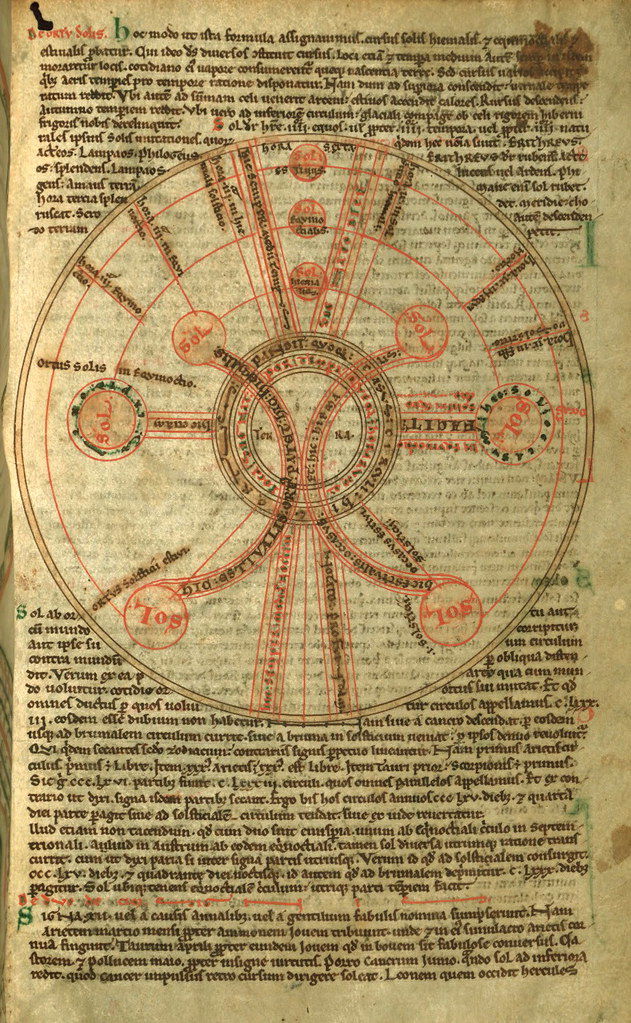
Diagram of the solstices and equinoxes from a late 12th-century English cosmography manuscript (Walters Art Museum, Ms. W.73). Public domain (CC0), via the Public Domain Image Archive.
Last checked: November 8, 2026.
The Full Wheel, With Exact Times
Traditional dates are fixed on the calendar. Astronomical moments are not, and they shift by a day or two from year to year. Here is the next full turn of the wheel.
| Festival | Traditional date | Astronomical moment (UTC) | What marks it |
|---|---|---|---|
| Yule | Dec 21 | Mon, Dec 21, 2026 · 20:50 | December solstice |
| Imbolc | Feb 1–2 | Thu, Feb 4, 2027 · ≈01:44 | Sun at 15° Aquarius |
| Ostara | Mar 20 | Sat, Mar 20, 2027 · 20:24–20:25 | March equinox |
| Beltane | May 1 | Wed, May 5, 2027 · ≈17:24 | Sun at 15° Taurus |
| Litha | Jun 21 | Mon, Jun 21, 2027 · 14:10–14:11 | June solstice |
| Lughnasadh | Aug 1 | Sat, Aug 7, 2027 · ≈17:27 | Sun at 15° Leo |
| Mabon | Equinox, Sept 21–24 | Thu, Sep 23, 2027 · ≈06:01–06:02 | September equinox |
| Samhain | Oct 31 | Sun, Nov 7, 2027 · ≈15:39 | Sun at 15° Scorpio |
Solstice and equinox times follow published tables built on observatory data, and sources can differ by a minute, so some rows show both. Times marked ≈ are cross-quarter points that we calculated ourselves: the moment the Sun reaches 15° of the sign. We tested the method against known solstice, equinox and sign-change times and it matched within a few minutes, so treat the ≈ times as good to about five minutes. For Mabon, one table lists 05:44 UTC, but most sources give about 06:01–06:02.
The same logic explains the date in our Samhain 2026 guide: the cross-quarter point landed on November 7 at 09:52 UTC, a week after Halloween.
Check the Yule Time Before You Plan Anything
Published tables built on IMCCE and Time and Date data, StarWalk, and Canada’s Espace pour la vie all land on the same moment for the December solstice: 20:50 UTC. (The Canadian page lists it as 15:50, which is the same instant in Montréal local time.)
At least one popular almanac page we checked on November 8 lists the solstice at 10:50 a.m. EST (15:50 UTC). That’s five hours earlier. It looks like a local Eastern time got read as UTC. If your ritual is timed to the minute, or you’re scheduling a live stream, use 20:50 UTC.
The same moment, in your time zone:
| City | Local time |
|---|---|
| Los Angeles | Mon, Dec 21, 12:50 p.m. |
| New York | Mon, Dec 21, 3:50 p.m. |
| London | Mon, Dec 21, 8:50 p.m. |
| Tunis / Paris | Mon, Dec 21, 9:50 p.m. |
| Cairo | Mon, Dec 21, 10:50 p.m. |
| Riyadh | Mon, Dec 21, 11:50 p.m. |
| Dubai | Tue, Dec 22, 12:50 a.m. |
| Tokyo | Tue, Dec 22, 5:50 a.m. |
| Sydney | Tue, Dec 22, 7:50 a.m. |
Mark your calendar for 2027 too. The December 2027 solstice falls at 02:42 UTC on December 22, so Yule starts a day later for much of Europe, Africa and Asia.
Why the Cross-Quarter Days Drift From the Traditional Dates
The four cross-quarter days sit roughly halfway between a solstice and an equinox. Astronomically, that’s when the Sun reaches 15° of Aquarius, Taurus, Leo or Scorpio. In 2027 that happens on February 4, May 5, August 7 and November 7. The traditional dates, February 1–2, May 1, August 1 and October 31, were set by the calendar. The Sun was never asked.
There’s also a third way. Hermetic Systems, which makes software for calendar calculations, points out that cross-quarter days are often confused with the Celtic festivals themselves. In some traditions the “true” dates follow the Moon: Imbolc at a dark moon with the Sun in Aquarius, and Beltane at a full moon with the Sun in Taurus.
Which Date Should You Use?
- Traditional: best if you want to share the moment with family, friends or your community.
- Astronomical: best if you want to follow the Sun. Use the table above.
- Lunar: best if the Moon guides your practice. Use the nearest new or full moon.
Some people mark all three. The only mistake is choosing none and letting the date slide by. Put it in your calendar today.
Southern Hemisphere: The Wheel Flips
South of the equator the seasons are reversed, so the wheel turns six months apart. Yule is the June solstice, on June 21, 2027 at 14:10–14:11 UTC. Samhain is the early-May cross-quarter, around May 5, 2027 at about 17:24 UTC. The astronomical moments are the same everywhere. Only the names move.
How to Mark Yule 2026: Simple Ideas
- Find your local time in the table above and put it in your calendar.
- Don’t expect to see it. The solstice instant is when the Sun reaches its farthest point south of the celestial equator. You can’t watch it happen, but you can watch the sunset on December 21, the shortest day in the north.
- Light a candle at sunset or at the exact minute. Never leave a flame unattended.
- Write two lines. What you’re carrying into the lengthening days, and what you’re putting down.
These are traditions and tools for reflection, not predictions. For real decisions about health, money or relationships, rely on qualified advice.
Frequently Asked Questions
When is Yule in 2026?
Yule is kept at the December solstice, which falls on Monday, December 21, 2026 at 20:50 UTC (3:50 p.m. Eastern).
When is Imbolc in 2027?
The traditional date is February 1–2. The astronomical cross-quarter moment, when the Sun reaches 15° Aquarius, falls on February 4, 2027 at about 01:44 UTC.
Why do the dates differ from the traditional ones?
Traditional dates are fixed on the calendar, while cross-quarter days follow the Sun’s position, so they arrive a few days later.
Is the winter solstice on December 21 or 22?
In 2026 it is December 21 in the Americas, Europe and Africa. In parts of Asia and Australia, where it is already past midnight, it is December 22 local time. In 2027, the solstice falls at 02:42 UTC on December 22.
Do the dates change in the Southern Hemisphere?
The astronomical moments are the same, but the names flip. The June solstice is Yule there, and the early-May cross-quarter is Samhain.
The sky keeps better time than any calendar. Pick the date that fits your practice, put it in your phone, and let the wheel do the turning.