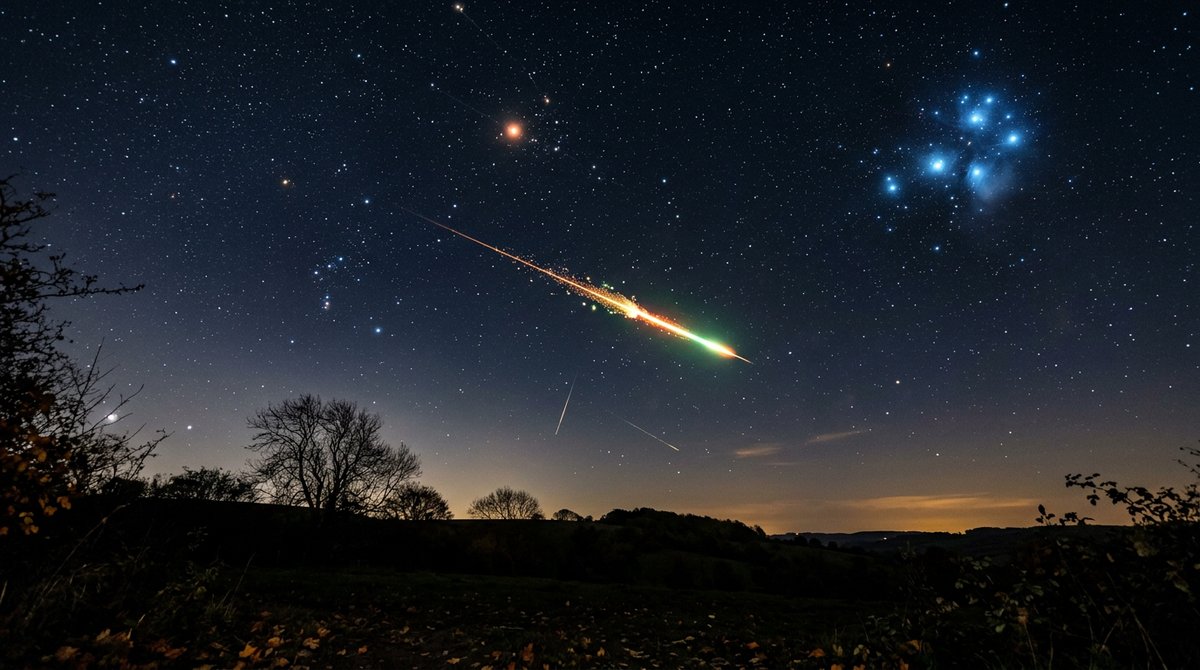
The Taurid meteor shower 2026 is not one shower but two, and this year both of their November peaks fall in dark, almost moonless skies. The Southern Taurids reach their fireball-rich maximum on the night of November 4–5, the Northern Taurids peak on November 11–12, and a New Moon on November 9 sits neatly between them. If you have ever wanted to see one of the slow, glowing “Halloween fireballs,” the first half of November 2026 is your window.
This guide gives you the verified dates (from the American Meteor Society, EarthSky and timeanddate), a night-by-night moon plan, realistic expectations about how many meteors you will actually see, and, for readers of this blog, a gentle reflective practice for watching the sky in the darkest weeks of autumn. The spiritual ideas are offered as invitations to reflect, not as claims about what meteors do.
Taurid Meteor Shower 2026 at a Glance
| Detail | Southern Taurids | Northern Taurids |
|---|---|---|
| Active period (AMS) | Sept 20 – Nov 20, 2026 | Oct 20 – Dec 10, 2026 |
| Peak night | Nov 4–5 (fireball component); annual component around Oct 14 | Nov 11–12 |
| RASC predicted peak time | 19:00 UTC, Nov 5 | 18:00 UTC, Nov 12 |
| Moon on peak night (AMS) | 25% lit, waning crescent | 4% lit, waxing crescent |
| Typical rate (dark sky) | About 5 per hour | About 5 per hour |
| Entry speed | About 27 km/s (17 mi/s) | About 29 km/s (18 mi/s) |
| Radiant | Constellation Taurus, near the Pleiades; highest around midnight | |
| Parent body | Comet 2P/Encke and the wider “Encke Complex” | |
Because the two streams overlap from late October into mid-November, a clear, dark night anywhere in that stretch can give you roughly 10 Taurids per hour combined, according to EarthSky. That is a modest number, but the Taurids are not about quantity.
Why the Taurids Are Called the “Halloween Fireballs”
The nickname has two halves. The first is timing: the Taurids are most noticeable from late October into early November, right around Halloween, when both branches are active together. The second is brightness. Taurid meteoroids hit the atmosphere slowly by meteor standards, at under 30 kilometers per second, and the stream carries some unusually large particles. When one of those larger pieces burns up, it can produce a fireball: a meteor brighter than the planet Venus that may crawl across the sky, change color and break apart.
As the American Meteor Society has explained, in most years only about 1% of Taurid meteors are fireballs. In exceptional “swarm” years, when Earth passes through a denser clump of debris, that share can rise to around 7%. Swarm years were seen in 2008, 2015 and 2022. The next predicted swarm is in 2032, so 2026 is a normal year. That is worth being honest about: you should not expect a fireball storm. But a normal Taurid season still produces fireballs, and 2026 gives you dark skies to catch them.
What a Taurid looks like
A typical shooting star from a fast shower like the Leonids is a quick white scratch that is gone in a blink. A Taurid is different. Space.com’s Jamie Carter put it well: you don’t just see a Taurid meteor, you watch it. Expect a slower, often yellow-orange streak, sometimes with a short-lived glow or fragments behind it. If you see one, note the time and direction; the American Meteor Society welcomes fireball reports from the public.
Southern Taurids 2026: Peak Night November 4–5
The Southern Taurids have been active since September 20 and will fade out around November 20. The AMS describes them as a complex shower with two components:
- The annual component, which peaked around October 14, close to the October 10 New Moon.
- The fireball-swarm component, which peaks around November 5. This is the night to circle if fireballs are your goal.
On the night of November 4–5, the Moon will be a waning crescent about 25% lit (AMS figure). It rises only in the early morning hours, so most of the night stays dark. The Royal Astronomical Society of Canada’s Observer’s Handbook, cited by EarthSky, puts the predicted peak at 19:00 UTC on November 5. In practice the Taurid maximum is broad, so the nights of November 3–4 and 5–6 are nearly as good.
Northern Taurids 2026: Peak Night November 11–12
The Northern Taurids switched on around October 20 and will continue until about December 10. Their peak arrives on the night of November 11–12, with RASC predicting 18:00 UTC on November 12. The Moon will be a slender waxing crescent only about 4% lit, setting shortly after the Sun. The AMS rates these lunar conditions as “very favorable.”
The Northern branch is believed to be tied to asteroid 2004 TG10 and several related objects whose orbits closely match Comet Encke. Like their southern cousins, they average about five meteors per hour but can surprise you with a bright one.
Your 2026 Moon Plan for the Taurids
Moonlight is the single biggest factor for any meteor shower. Here is how the Moon behaves through the Taurid season in 2026, with times in UTC from timeanddate:
| Date (UTC) | Moon phase | What it means for Taurid watching |
|---|---|---|
| Oct 26, 04:11 | Full Moon (Hunter’s Moon) | Bright all night; only fireballs will stand out |
| Oct 31 (Halloween) | Waning gibbous, just over half lit | Watch in the evening before moonrise |
| Nov 1, 20:28 | Last Quarter | Moon rises around midnight; evenings dark |
| Nov 4–5 | Waning crescent (~25%) | Southern Taurid fireball peak, mostly dark |
| Nov 9, 07:02 | New Moon | Darkest skies of the season |
| Nov 11–12 | Waxing crescent (~4%) | Northern Taurid peak, excellent conditions |
| Nov 17, 11:47 | First Quarter | Evening moonlight returns |
The takeaway: November 3 to November 13 is the sweet spot of the 2026 Taurid season, a ten-day dark window that covers both peaks. EarthSky sums it up simply: moonlight will not interfere with the Taurids in 2026.
How to Watch the Taurids (Step by Step)
1. Pick your hours
Taurus rises in the early evening and climbs highest around midnight. Meteor rates usually improve as the radiant gets higher, so the hours from about 10 p.m. to 3 a.m. local time are ideal. A nice bonus of the Taurids: because the radiant is up so early, you can catch a few even before midnight, which is rare for meteor showers.
2. Find real darkness
Get away from streetlights and city glow if you can. Even a short drive to a park or rural road makes a large difference. Give your eyes 20 to 30 minutes to adapt, and avoid looking at your phone; if you need light, use a red one.
3. Look broadly, not at Taurus
Meteors can appear anywhere in the sky. Their trails simply point back toward the radiant near the Pleiades. Lie back on a reclining chair and take in as much sky as possible. Binoculars and telescopes narrow your view too much to be useful for meteors.
4. Be patient
Five meteors per hour means you might wait 15 minutes between them. Bring warm layers, a blanket and a hot drink. The Taurids reward people who settle in for an hour or more rather than glancing up for five minutes.
5. Report what you see
If you witness a fireball, the American Meteor Society’s online fireball report form lets you log it. Reports from many people help scientists calculate the object’s path.
Where the Taurids Come From: Comet Encke
Both Taurid branches are linked to Comet 2P/Encke, which NASA describes as having the shortest orbital period of any known major comet: about 3.3 years. At its closest it comes roughly as near the Sun as Mercury does. Encke’s next return is expected in July 2030.
Astronomers think Encke is part of a much larger family of debris and objects, called the Encke Complex, possibly left over from the breakup of a bigger comet roughly 20,000 years ago. Each autumn Earth sweeps through different parts of this wide, old stream, which is why the Taurids are so long-lasting and why their peaks are soft rather than sharp. EarthSky notes that published peak dates vary between sources for exactly this reason.
The Spiritual Side: A Reflective Way to Watch
Nothing in this section is a scientific claim. It is a way of giving the sky your attention, which many people find meaningful in itself.
Taurus and Scorpio: the axis of what lasts
During the Taurid peaks the Sun is moving through Scorpio, while the meteors seem to stream out of Taurus on the opposite side of the zodiac. In astrological symbolism, Taurus is linked with steadiness, the body and what we value, and Scorpio with depth, endings and transformation. If you enjoy that language, the Taurid season can be a prompt to ask: What in my life is worth keeping, and what am I ready to let burn away?
Slow light in a fast world
The Taurids are, quite literally, slow meteors. That can be a quiet invitation to slow down. Instead of chasing a big number of shooting stars, you are practicing waiting, noticing and staying present in the dark, a skill that carries well into daily life.
A simple fireball reflection practice
- Before you go out, write down one thing you want to release and one thing you want to grow before the year ends.
- Once your eyes adjust, spend a few minutes just breathing and noticing the stars around the Pleiades.
- Each time you see a meteor, silently name the thing you are releasing.
- If you are lucky enough to catch a fireball, pause and name the thing you want to grow.
- Back inside, add a line to your journal about how the waiting felt.
The November 9 New Moon falls right between the two peaks, which makes it a natural midpoint for this practice. You can read more about that lunation in our guide to the New Moon in Scorpio on November 9, 2026. And if you mark the old Celtic turning of the year, the Taurid window also contains the true astronomical cross-quarter day, explained in our post on Samhain 2026 and the November 7 cross-quarter day.
What Comes After the Taurids
November and December 2026 are a strong stretch for meteor watchers. As the Northern Taurids wind down, the Leonids peak on the night of November 16–17 under a 39% waxing crescent (AMS). See our full Leonid meteor shower 2026 guide for timing. Then the year’s strongest shower, the Geminids, peaks on December 13–14 with only a 15% crescent Moon; our Geminid meteor shower 2026 guide covers the best time by region.
Frequently Asked Questions
When is the Taurid meteor shower in 2026?
The Southern Taurids are active from September 20 to November 20, 2026, with their fireball peak on the night of November 4–5. The Northern Taurids run from October 20 to December 10, 2026, peaking on the night of November 11–12. Both dates come from the American Meteor Society.
What is the best night to see Taurid fireballs in 2026?
The night of November 4–5 is the AMS peak for the Southern Taurids’ fireball component, with only a 25%-lit crescent Moon rising late. The night of November 11–12 is a close second, with an almost absent 4% crescent Moon.
How many Taurid meteors per hour can I expect?
Each branch produces about five meteors per hour under ideal dark skies, and around ten per hour combined when the two overlap in late October and early November. Real counts are usually lower because of light pollution and the radiant’s height.
Is 2026 a Taurid fireball swarm year?
No. Swarm years with more fireballs occurred in 2008, 2015 and 2022, and the next predicted swarm is in 2032. Normal-year fireballs are still possible in 2026, and the dark skies improve your chances of seeing them.
Can I see the Taurids from the Southern Hemisphere?
Yes. Taurus lies close to the ecliptic, so the Taurids are visible from both hemispheres. Southern observers see the radiant lower in the northern sky, but bright Taurids can still be spotted.
What time of night is best for the Taurids?
Around midnight local time, when Taurus is highest. Because the radiant rises in the early evening, you can also see some Taurids from about 9 or 10 p.m.
Do the Taurids have a spiritual meaning?
There is no scientific spiritual meaning. Many people simply use meteor showers as moments for reflection, intention-setting or gratitude. On this blog we frame the Taurids, which arrive during Scorpio season from the direction of Taurus, as a prompt to consider what to keep and what to release before the year ends.
Sources
- American Meteor Society: Meteor Shower Calendar 2026/2027
- EarthSky: Taurid meteors in 2026, all you need to know
- timeanddate: Moon Phases 2026
- NASA: Comet 2P/Encke
- Space.com: The ‘Halloween Fireballs’ are coming
Dates and times are from the sources above; meteor shower peaks are predictions and can shift by a day or so. Spiritual reflections in this article are personal and contemplative, not scientific claims.