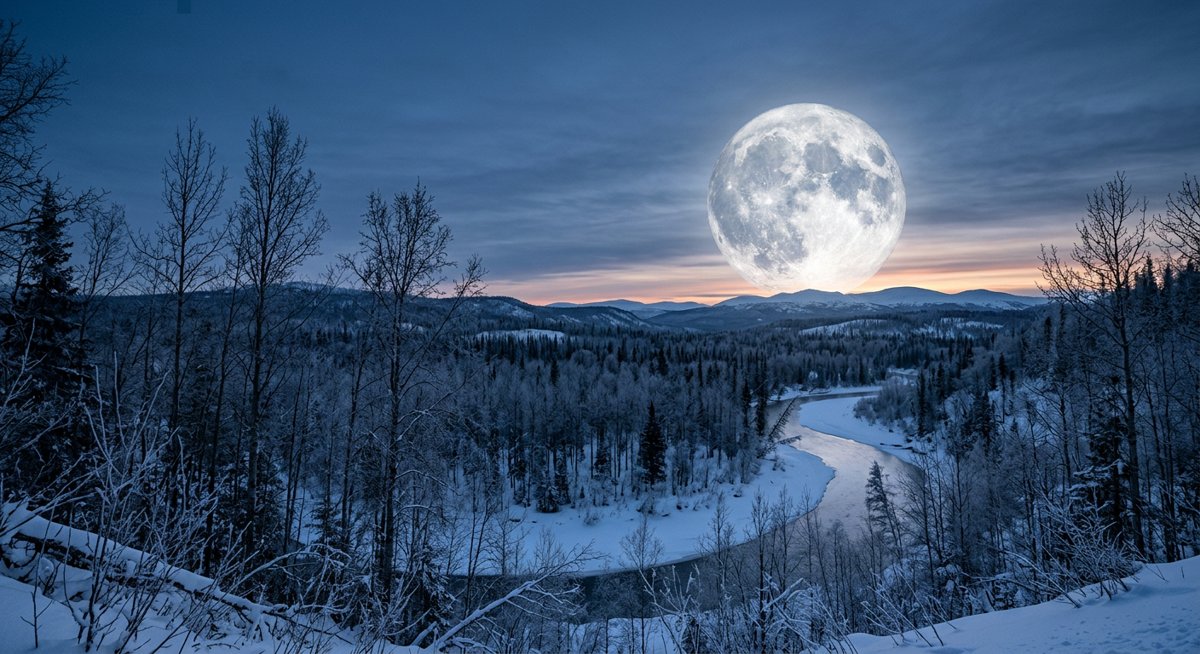
The Cold Moon of December 2026 is the last full Moon of the year, and it is also the closest one. It reaches its exact full phase on December 24, 2026 at 01:28 UTC, which is the evening of December 23 across the Americas (8:28 p.m. EST). Because it lands only a couple of nights before Christmas and just after the winter solstice, many people are asking what to expect. This guide gives you verified times for your region, the real distance numbers behind the supermoon label, a simple viewing plan, and a reflective section for anyone who likes to use the long December nights for quiet intention-setting.
Cold Moon 2026 at a Glance
| Detail | Value |
|---|---|
| Exact full phase (UTC) | Thursday, December 24, 2026, 01:28 |
| New York (EST) | Wednesday, December 23, 8:28 p.m. |
| Pacific (PST) | Wednesday, December 23, 5:28 p.m. |
| London (GMT) | Thursday, December 24, 1:28 a.m. |
| Central Europe / Tunis (CET) | Thursday, December 24, 2:28 a.m. |
| Distance at full phase | about 356,700 km (about 221,700 miles) |
| Supermoon? | Yes, the closest full Moon of 2026 |
Times come from timeanddate.com (New York local time), the Old Farmer's Almanac and BBC Sky at Night Magazine. Sources differ by a few kilometres on the distance (356,729 to 356,763 km depending on the calculation), which is normal and does not change anything you will see.
Why It Is Called the Cold Moon
The name comes from the Native North American and European folk tradition of naming each full Moon after the season. December's Moon is the Cold Moon because winter cold sets in, and it is also known as the Long Nights Moon or the Moon before Yule. These are seasonal nicknames, not scientific categories. Other months follow the same pattern; see our guide to the Beaver Supermoon of November 24, 2026 for the previous one.
Is It Really a Supermoon?
A supermoon is a full Moon that occurs within about 90 percent of the Moon's closest approach to Earth (perigee). It is a popular term rather than a formal astronomical one, so different sites count slightly differently. By the usual definition, 2026 has three: the Wolf Moon on January 3, the Beaver Moon on November 24, and this Cold Moon on December 24.
The Numbers
| 2026 supermoon | Full phase | Approx. distance |
|---|---|---|
| Wolf Moon | Jan 3 | 362,312 km |
| Beaver Moon | Nov 24, 14:53 UTC | about 360,760 km |
| Cold Moon | Dec 24, 01:28 UTC | about 356,740 km |
According to the BBC Sky at Night Magazine, citing Fred Espenak's tables, the Moon reaches perigee itself about seven hours after full phase, at 08:30 UTC on December 24. A supermoon looks only a little bigger and brighter than average: roughly 8 percent wider and 16 percent brighter than a full Moon at average distance. Without a comparison, most people will not notice the size difference; the real treat is its height in the sky.
Why It Rides So High
The full Moon sits opposite the Sun. In December the Sun is at its lowest in the Northern Hemisphere, so the full Moon is at its highest. At mid-northern latitudes it stays above the horizon for around 15 hours. Under the traditional zodiac (tropical) system the Moon is in Cancer at this full phase, while astronomically it appears in front of the stars of Gemini, forming a triangle with Castor and Pollux according to Sky at Night. Those two statements do not conflict: astrology uses the seasonal zodiac, astronomy uses the actual constellations.
When and How to Watch
Best Nights
The Moon looks full to the eye for about three nights, December 22 to 24, and is still around 97 percent lit on Christmas night. Moonrise is near sunset, around 16:00 to 16:10 local time in the UK and similar in the northern United States, so you do not need to stay up late.
A Simple Viewing Plan
- Check your local moonrise time with a moonrise calculator for your city.
- Find a clear eastern or north-eastern horizon with trees or buildings in the foreground.
- Arrive 15 minutes before moonrise; the Moon looks largest near the horizon because of the Moon illusion, which is a perceptual effect rather than a real change in size.
- Dress warmly. It is called the Cold Moon for a reason.
- Look for Orion to the east and Jupiter and Mars nearby in the evening sky, as described by Sky at Night.
Photography Tips
Use a tripod, a zoom lens of 200 mm or more if you have one, and lower your exposure compensation, because a full Moon is far brighter than it appears. Shooting just after moonrise lets you include the landscape. A phone in night mode on a steady surface also works for atmospheric wide shots.
The Bigger December Sky Calendar
| Event | Date |
|---|---|
| New Moon | Dec 8, 2026 (7:51 p.m. EST; Dec 9, 00:51 UTC) |
| Geminids peak | Night of Dec 13-14 |
| First Quarter | Dec 17 (12:42 a.m. EST) |
| Winter solstice | Dec 21, 2026 |
| Ursids peak | Dec 21-22 (approx.) |
| Cold Moon | Dec 24, 01:28 UTC |
| Third Quarter | Dec 30 (1:59 p.m. EST) |
Read more in our guides to the Geminid meteor shower 2026, the Ursid meteor shower 2026, and the winter solstice 2026. The solstice marks the longest night, and the Cold Moon arrives only about three days later, so the week offers both the darkest nights and the brightest Moonlight of the year.
A Reflective Guide for the Long Nights
Please note: what follows is reflection, not prediction. There is no scientific evidence that a full Moon changes events, health or behaviour, and nothing here should replace professional advice. Many people simply find that a bright night in the quiet of winter is a good prompt to pause. If that appeals to you, here are some gentle ideas.
Year-End Review
Traditionally, a full Moon is a symbol of culmination. You can use it as a calendar anchor to ask a few questions:
- What did I complete this year that I did not celebrate?
- What am I still carrying that I can set down?
- Who deserves a call or a message of thanks?
Cancer Themes, Symbolically
In the astrological tradition, Cancer is linked with home, family and nourishment. Falling on Christmas Eve, this Moon is a natural cue for many people to think about those themes: a shared meal, a call to a relative, or simply making your living space feel warm. Treat this as symbolism you may or may not find meaningful.
A Ten-Minute Moonlight Ritual
- Step outside or sit by a window once the Moon is up.
- Take five slow breaths.
- Write down three things you are grateful for and one intention for 2027.
- Put the note somewhere you will see it in January.
Cold Moon Around the World
Because the Moon is full at one single instant everywhere, the local date depends on your time zone. In Australia the moment falls around midday on Christmas Eve (12:28 p.m. in eastern Australia), so you will see the Moon rise that evening at about 97 to 99 percent lit. In the Southern Hemisphere the December full Moon is generally lower in the sky because it is summer there, which makes it a good moment for horizon photography. In Europe and North Africa the exact moment falls in the small hours of December 24, so the best view is the evening before or after. Wherever you are, the nights of December 23 and 24 are the best bet, and a clear sky matters more than the minute of peak.
What to Expect Next
The next supermoons in the sequence are the Wolf Moon on January 22, 2027 and the Snow Moon on February 20, 2027, according to the Old Farmer's Almanac and Futura-Sciences. If you enjoy marking the lunar year, December is a good month to start a simple moon journal: write the date, the sky conditions and one sentence about how the day felt. By the Wolf Moon you will have a small, personal record to look back on, regardless of what you believe about the Moon's influence.
Frequently Asked Questions
When is the Cold Moon in December 2026?
The exact full phase is December 24, 2026 at 01:28 UTC. In the Americas that is the evening of December 23; for example 8:28 p.m. EST.
Is the December 2026 Cold Moon a supermoon?
Yes. At roughly 356,700 km it is the closest full Moon of 2026 and the third supermoon of the year by the common 90 percent definition.
Will the Cold Moon look much bigger?
Not dramatically. A supermoon is about 8 percent wider and 16 percent brighter than an average full Moon, which most people only notice side by side with photos.
Why is it called the Cold Moon?
The name comes from seasonal folk tradition in North America and Europe, marking the arrival of winter cold. It is also called the Long Nights Moon.
Does the Cold Moon fall on Christmas Eve?
In UTC and Europe, yes, early on December 24. In the United States the exact moment is the evening of December 23, though the Moon still looks full on Christmas Eve.
What is the best time to see the Cold Moon?
Just after moonrise, around sunset, when it sits low and glows near the horizon. It then rises high and stays up most of the night.
Sources
- timeanddate.com, Moon Phases 2026 (New York times) and Cold Moon page
- Old Farmer's Almanac, Full Cold Supermoon December 2026
- BBC Sky at Night Magazine, Christmas Eve supermoon 2026
- EarthSky, What is a supermoon (Espenak perigee list)
- Farmers' Almanac, Cold Moon 2026