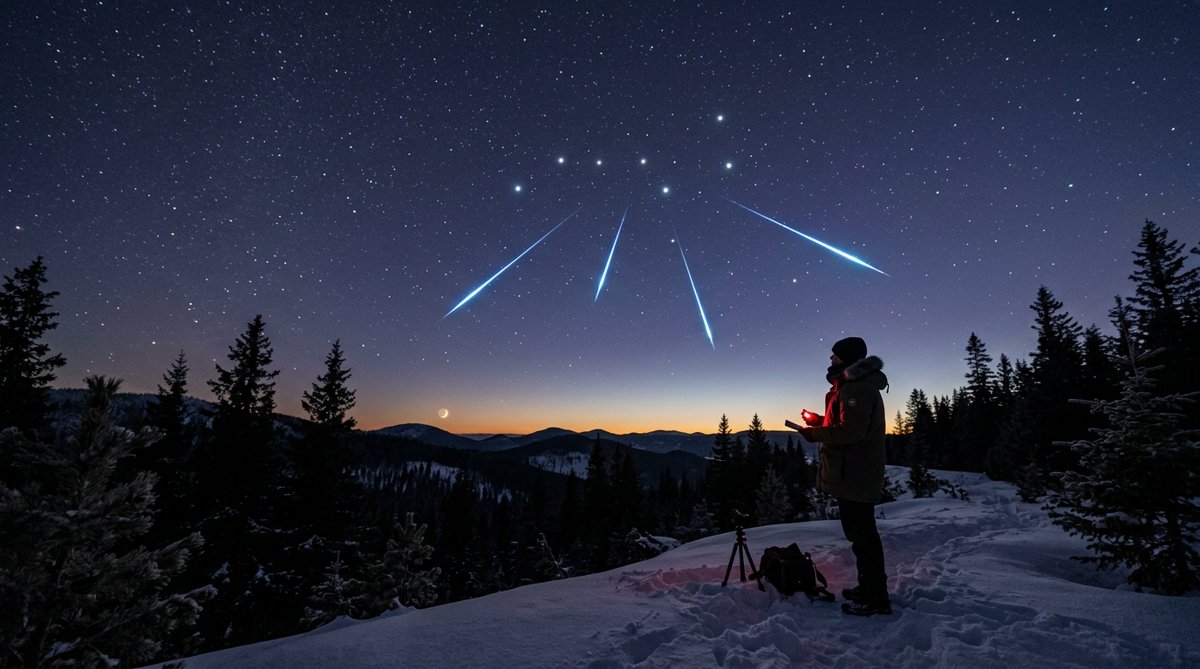
The first meteor shower of the year is also one of the most unusual: the Quadrantids pour out of the northern sky for only a few hours, then they are gone. In 2027 the timing is unusually kind. The peak falls on the night of January 3 to 4, 2027, just days before the New Moon, so a thin waning crescent will barely touch the sky. This guide gives you the verified dates, a simple moon and time plan, a how-to for watching, and a short reflective section for those who like to pair the sky with intention.
Quadrantid Meteor Shower 2027 at a Glance
| Detail | 2027 value |
|---|---|
| Active period | December 28, 2026 to January 12, 2027 |
| Peak night | January 3 to 4, 2027 |
| Predicted peak (IMO) | January 4, about 03:25 UT |
| Predicted peak (American Meteor Society) | About 03:30 UT on January 4 |
| Predicted peak (EarthSky) | 05:47 UTC on January 4 |
| Radiant | Constellation Boötes, near the Big Dipper |
| Parent body | Asteroid 2003 EH1, possibly an extinct comet |
| Moon at peak | Thin waning crescent, roughly 12 to 18% lit depending on the source and the exact hour |
| Next New Moon | January 7, 2027 (20:24 UTC per EarthSky) |
Note that sources differ by a couple of hours on the predicted peak. That is normal: the Quadrantid stream is narrow, and the exact timing is hard to forecast. The International Meteor Organization even lists the peak timing as uncertain by a couple of hours.
Why the Quadrantids Are Different
Most showers build slowly and fade slowly over a day or two. The Quadrantids do not. According to EarthSky and the American Meteor Society, the peak lasts only about six hours. That is why the shower has a reputation for being the strongest of the year on paper, yet often falling short in practice: if your longitude or your clouds are wrong, you miss it.
The IMO calendar for 2027 rates the ideal rate (ZHR) around 80, with a possible range of roughly 60 to 200. The American Meteor Society says a realistic rate under dark skies is closer to 25 per hour. Treat both numbers as ceilings, not promises. City lights, haze, and a low radiant all reduce what you will see.
The parent body
NASA lists the source as 2003 EH1, described as an asteroid or possibly a "rock comet." Its debris crosses Earth's orbit at about 41 km/s, so the meteors are fast and often bright, sometimes with fireballs. The old constellation Quadrans Muralis, now defunct, gave the shower its name.
Who Has the Best View?
The American Meteor Society notes the 2027 timing favors Europe and western Asia, because the predicted peak lands in the small hours there. Observers in North America would see the peak around 10:30 p.m. Eastern on January 3 (03:30 UT converted), when the radiant is still low. The shower is also hard to see from the Southern Hemisphere because of the radiant's northern position.
| Region | Local time of 03:30 UT peak | Comment |
|---|---|---|
| Tunisia / Central Europe (UTC+1) | 04:30 on January 4 | Radiant high, ideal pre-dawn window |
| United Kingdom (UTC) | 03:30 on January 4 | Very good |
| US Eastern (UTC-5) | 10:30 p.m. on January 3 | Radiant low, watch before dawn too |
| US Pacific (UTC-8) | 7:30 p.m. on January 3 | Radiant low, watch before dawn |
Moon Plan for the Quadrantids 2027
The Moon is the biggest winner this year. Sources give slightly different illumination figures (about 12% from several calculators, 18% from the American Meteor Society for the whole night), but all agree: it is a waning crescent that rises only in the hours before dawn, low in the south-east, far from the radiant.
| Date | Moon | Impact |
|---|---|---|
| January 1 | Waning, about 38% lit | Moderate late-night light |
| January 3 | Waning crescent, about 20% lit | Minor |
| January 4 (peak) | Waning crescent, about 13% lit | Very small |
| January 7 | New Moon | Dark sky for the tail of the shower |
These percentages come from MeteorShowerCal and are rounded; check a local almanac for your exact location. For the official moon phase tables, see timeanddate.com.
How to Watch the Quadrantids
- Pick the right night. Plan for the night of January 3 to 4, and try January 2 to 3 and 4 to 5 as backup, since cloud is common in early January.
- Go dark. Get away from streetlights. Let your eyes adapt for at least 15 minutes, as the Royal Observatory Greenwich advises.
- Dress for the cold. A sleeping bag or a reclining chair, a hat, and a warm drink matter more than any equipment.
- Look broadly. No telescope or binoculars are needed. The meteors appear anywhere, and trails point back toward Boötes.
- Time it. In Europe, aim for roughly 02:00 to 06:00 local time. The radiant climbs through the night, so later is usually better.
- Be patient. Give it at least an hour. Meteor counts come in bursts.
Photography tips
Use a wide lens, a sturdy tripod, ISO 1600 to 3200, an aperture as open as possible, and 10 to 20 second exposures. Take many frames; luck decides which one catches a bright meteor.
What to Expect Night by Night
Because the active window stretches from December 28 to January 12, you do not have to wait for the single peak night to see something. Early in the window, activity is very low, and you may count only an occasional meteor per hour. Rates rise sharply in the day or so around the maximum, then collapse just as quickly. That steep rise and fall is the signature of the shower and the reason experienced observers plan around the predicted time rather than simply picking a convenient evening.
Another thing worth knowing is that fireballs are a feature of this shower. The AMS notes that Quadrantid meteors usually lack persistent trains but often produce bright fireballs, so even a modest hourly count can include a memorable bright streak. If you photograph, keep the camera pointed toward the north-east to north sky and leave it running for the whole session, because the brightest meteor tends to arrive when you step away for a hot drink.
Backup plan for cloudy skies
Early January weather is a gamble. timeanddate notes that, historically, January 3 to 4 has been cloudy a large share of the time at many locations. Check forecasts a few days ahead, be willing to drive to a clearer area, and remember that a lower-rate night a day before or after the peak is still a lovely night under the stars.
A Reflective Look: Beginning the Year Under Falling Stars
None of what follows is a prediction or a scientific claim. Meteors are small grains of rock burning up in our atmosphere, and they carry no message about your life. Still, people across cultures have used moments like this to pause. The Quadrantids arrive in the first days of January, when many of us think about fresh starts, and the sky offers a quiet, free setting for it.
A simple practice
- Before you go out, write down one intention for 2027 in a single sentence.
- While you wait, put the phone away and notice your breath and the cold air.
- Each time a meteor flashes, you might mentally name something you are ready to release or begin.
- Afterwards, write one line about how the night felt. The value is in the pause, not in the meteor count.
If you enjoy tying these moments to the wider calendar, the New Moon of January 7 is a natural companion: it comes just after the shower and is a traditional time for setting intentions. We explored that theme in our guide to the New Moon in Capricorn, January 2027.
Plan Your Meteor Season
If you are building a sky calendar for the winter, our guides to the Geminid meteor shower 2026 and the Ursid meteor shower 2026 cover the two showers that come before the Quadrantids. Together they make a good three-shower run from mid-December into early January, with the Geminids being the busiest and the Ursids the quietest.
Frequently Asked Questions
When is the Quadrantid meteor shower in 2027?
It is active from December 28, 2026 to January 12, 2027, with the peak on the night of January 3 to 4, 2027. The IMO predicts the maximum at about 03:25 UT on January 4.
Will the Moon interfere with the Quadrantids in 2027?
No, it should not. A thin waning crescent, roughly 12 to 18% lit depending on the source, rises late. The New Moon follows on January 7.
How many meteors per hour can I expect?
The IMO gives a ZHR near 80, while the American Meteor Society suggests about 25 per hour under dark skies. Real counts depend on your sky and the radiant's height.
Why is the Quadrantid peak so short?
The stream of debris from asteroid 2003 EH1 is very narrow, so Earth crosses its densest part in only about six hours.
Where should I look to see Quadrantids?
Look at the whole sky, ideally high up and away from the Moon. The meteors radiate from Boötes, near the Big Dipper, in the northeast to north sky.
Do I need a telescope?
No. The naked eye is best because it covers the whole sky. Just allow 15 minutes for your eyes to adapt to the dark.
Sources
- International Meteor Organization, 2027 Meteor Shower Calendar (imo.net)
- American Meteor Society, 2026/2027 Meteor Shower Calendar (amsmeteors.org)
- EarthSky, Quadrantid meteor shower 2027 (earthsky.org)
- NASA Science, Quadrantids (science.nasa.gov)
- timeanddate.com, Quadrantids meteor shower 2027
- Royal Observatory Greenwich, Quadrantid meteor shower guide (rmg.co.uk)
- MeteorShowerCal, Quadrantids 2027 (meteorshowercal.com)
Peak predictions can shift by hours; confirm closer to the date. Spiritual reflections are personal and contemplative, not scientific fact.